
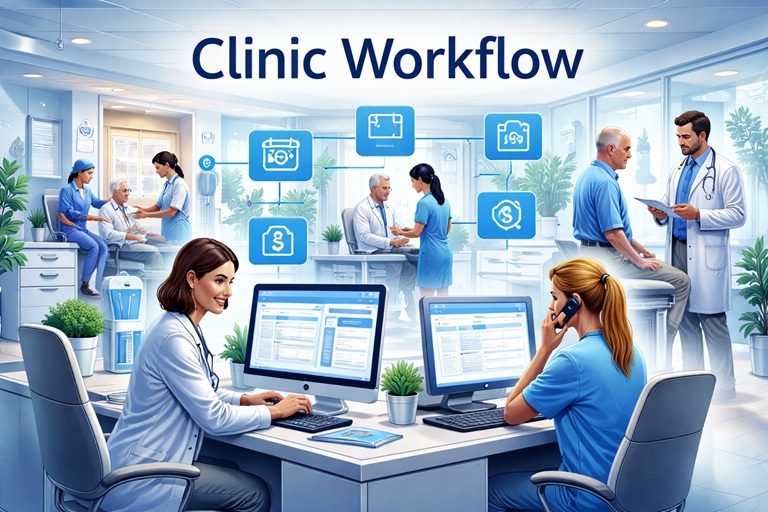
In the rapidly evolving landscape of healthcare, clinic managers, hospital administrators, and healthcare IT professionals face an ever-increasing demand for efficiency, patient satisfaction, and operational resilience. As we look towards 2026, the need for robust, optimized workflows isn't just a best practice—it's a critical imperative for sustainable growth and delivering exceptional patient care. Manual bottlenecks, siloed information, and outdated processes are no longer viable in a world driven by digital transformation and rising patient expectations.
At MedCueAI, we understand these challenges intimately. Our premium Hospital Management Systems (HMS) and Clinic Management Systems (CMS) are designed to be the backbone of your operational excellence. This post will guide you through 5 essential steps to optimize your clinic workflows by 2026, leveraging cutting-edge technology and strategic planning to transform your practice.
The Imperative of Clinic Workflow Optimization in 2026
The healthcare sector is dynamic, influenced by technological advancements, regulatory changes, and shifting patient demographics. By 2026, clinics that haven't streamlined their operations risk falling behind in terms of patient experience, staff retention, and financial performance. Optimized workflows translate directly into:
- Improved Patient Experience: Shorter wait times, easier access to information, and personalized care.
- Enhanced Operational Efficiency: Reduced administrative burden, fewer errors, and faster service delivery.
- Increased Staff Satisfaction: Empowered teams, less burnout, and clearer responsibilities.
- Better Financial Health: Optimized revenue cycle management, reduced overheads, and increased capacity.
- Data-Driven Decision Making: Actionable insights for continuous improvement and strategic planning.
1. Conduct a Comprehensive Workflow Audit & Analysis
Before you can optimize, you must understand what needs optimizing. The first critical step is a thorough audit of your existing clinic workflows. This isn't just about identifying problems; it's about mapping every touchpoint, every task, and every handoff from a patient's initial contact to post-visit follow-up.
- Process Mapping: Visually document every step of your patient journey and administrative tasks. Identify where delays occur, where information gets lost, or where tasks are duplicated.
- Time-Motion Studies: Quantify the time spent on various activities. How long does check-in take? How much time is spent on manual data entry?
- Staff Interviews & Feedback: Your front-line staff often have the best insights into operational inefficiencies. Gather their perspectives on pain points and potential solutions.
- Data Analysis: Leverage existing data from your current systems (or lack thereof) on patient wait times, appointment no-shows, billing cycles, and resource utilization.
MedCueAI's Role: Our HMS/CMS provides an invaluable data repository for this audit. Detailed logs of appointment scheduling, patient check-in/check-out times, and billing processes offer concrete metrics to pinpoint bottlenecks, making the audit process more data-driven and objective.
2. Embrace Advanced Healthcare Technology (HMS/CMS as the Core)
Once you've identified areas for improvement, the next step is to embrace technology as your primary enabler. By 2026, an integrated and intelligent HMS/CMS is non-negotiable for any clinic aiming for peak efficiency.
- Centralized EMR/EHR: Move beyond fragmented paper charts or disparate digital systems. A unified Electronic Medical Record (EMR) or Electronic Health Record (EHR) system ensures all patient data is accessible, accurate, and up-to-date across all departments.
- Automated Scheduling & Reminders: Implement online appointment booking systems and automated SMS/email reminders to reduce no-shows and administrative burden.
- Integrated Billing & Revenue Cycle Management (RCM): Streamline insurance verification, claims submission, payment processing, and denial management to accelerate cash flow and minimize errors.
- Patient Portals & Telehealth Integration: Offer secure communication channels, prescription refill requests, access to lab results, and virtual consultation options to meet modern patient demands.
MedCueAI's Role: Our comprehensive HMS/CMS integrates all these functionalities and more into a single, intuitive platform. From robust EMR/EHR capabilities to advanced RCM and patient engagement tools, MedCueAI serves as the central nervous system for your clinic, eliminating data silos and automating routine tasks.
3. Streamline the Patient Journey & Experience
A truly optimized clinic places the patient experience at its heart. By 2026, patients expect convenience, transparency, and personalized care. Optimizing the patient journey involves enhancing every interaction point, from initial contact to post-visit follow-up.
- Digital Intake & Registration: Replace clipboards with secure, online pre-registration forms that patients can complete from home, reducing wait times and ensuring data accuracy upon arrival.
- Efficient Check-in/Check-out: Implement kiosk-based check-in or mobile check-in options. For check-out, ensure clear next steps, easy payment options, and immediate access to post-visit summaries.
- Seamless Communication: Utilize secure messaging through a patient portal for follow-up questions, prescription refills, and sharing educational materials.
- Personalized Care Paths: Leverage data to offer tailored recommendations, preventive care reminders, and educational content relevant to each patient's health profile.
MedCueAI's Role: Our patient portal and communication modules are designed to enhance the patient journey significantly. From pre-arrival forms to secure messaging and self-scheduling, MedCueAI empowers patients while reducing the administrative load on your staff, contributing to higher satisfaction scores and retention.
4. Empower Staff Through Training & Automation
Technology is only as good as the people using it. Empowering your staff through continuous training and strategic automation is crucial for maximizing the benefits of your optimized workflows.
- Comprehensive Training Programs: Invest in regular, hands-on training for all staff members on new systems and optimized procedures. Ensure they understand the 'why' behind changes, not just the 'how.'
- Cross-Training & Task Delegation: Foster a culture of cross-training to build a more resilient and flexible team, capable of supporting various functions during peak times or staff absences.
- Automate Repetitive Tasks: Identify tasks that can be automated by your HMS/CMS, such as appointment reminders, eligibility checks, prior authorizations, and routine billing inquiries. This frees up staff for more complex, patient-facing roles.
- Leverage AI and Machine Learning: Explore how AI tools within your HMS/CMS can assist with clinical decision support, predictive analytics for resource allocation, or even transcribing clinical notes.
MedCueAI's Role: MedCueAI is built with user-friendliness in mind, minimizing the learning curve. We also offer comprehensive training resources and support. Our system automates numerous administrative and clinical tasks, empowering your staff to focus on direct patient care, thereby increasing job satisfaction and productivity.
5. Implement Continuous Monitoring, Feedback, & Iteration
Workflow optimization is not a one-time project; it's an ongoing commitment. The healthcare landscape is constantly changing, and your workflows must adapt accordingly. By 2026, clinics will need agile systems for continuous improvement.
- Define & Track Key Performance Indicators (KPIs): Regularly monitor metrics such as patient wait times, appointment availability, claim denial rates, patient satisfaction scores (PSAT), and staff productivity.
- Establish Feedback Loops: Create formal and informal channels for staff and patients to provide feedback on workflows. Regular team meetings should include discussions on what's working and what needs adjustment.
- Regular System Audits & Updates: Stay abreast of the latest features and updates from your HMS/CMS provider. Periodically review how your system is being utilized and if new functionalities can further enhance efficiency.
- Foster a Culture of Continuous Improvement: Encourage staff to identify areas for innovation and empower them to suggest and implement small, iterative improvements.
MedCueAI's Role: Our HMS/CMS includes robust analytics and reporting dashboards, providing real-time insights into your clinic's performance. These tools allow administrators to track KPIs, identify trends, and make data-driven decisions for ongoing workflow refinement, ensuring your clinic remains competitive and efficient well into 2026 and beyond.
Future-Proof Your Clinic with MedCueAI
Optimizing your clinic's workflows by 2026 is an investment in your future. By following these five steps—from a meticulous audit to continuous iteration—and by leveraging the power of advanced healthcare technology like MedCueAI's HMS and CMS, you can achieve unparalleled operational efficiency, elevate the patient experience, and empower your staff.
Don't just adapt to the future of healthcare; shape it. Explore how MedCueAI can be your partner in achieving peak efficiency and delivering superior care. Contact us today for a demo and discover the MedCueAI difference.